

The Vibrational Singing Chair from feeltone has served as an important instrument for the patients we serve at the Louis Armstrong Center for Music and Medicine at Beth Israel Medical Center in our Music Therapy program.
I've appreciated the ability to tune the strings and have used consonant intervals — made profound in octaves, fourths, and fifths. Most often, I tune the chair strings in octaves.

For several years, we kept the chair in our clinic where it served as a warm-up for many patients and staff who entered the Center. For doctors, nurses, and others, it was immediately an eye-catcher — the wood is attractive and resembles nature. Posed in the corner reception area, many would ask: "What is that chair?" As we described it as a "vibration chair used for healing," staff would ask: "May I try it out?"

For one nurse manager, the chair became a ritual. On stressful days, she would come to the Center and request a session. Her complaints were migraines. I used the highest and lowest strings on an "ee" vowel breath release — tonal vocal holding, my voice blanketing her pain and slowing the rhythm of the pulsating head pounds she described.
In a general way, this warm-up takes only about five minutes and creates a sense of flow, homeostasis, and synchrony between body, mind, and spirit — as one of my musician players often says.
One patient was an opera singer using the chair for neuropathic pain — constant, radiating from her neck to her fingers and toes. At stressful times the pain was so severe she would arrive with flat affect and white coloring, tears filling her eyes: "I am in horrible pain — ALL of the time." Medication was not taking effect; her hands were twitching and eyes squinting.
For severe pain, the vibration chair has had a profound effect. Starting with low solo tones and a tighten-and-release muscle relaxation focusing on each part of the body, I then direct tones from dissonant strings into consonant intervals — my method of tonal intervallic synthesis. We invoke an image of flow, often water, and then begin vocal warm-ups: softly, smoothly, on long tones of supported vibrational air.
And then she reports: "I am pain-free…. I am ready to sing now."
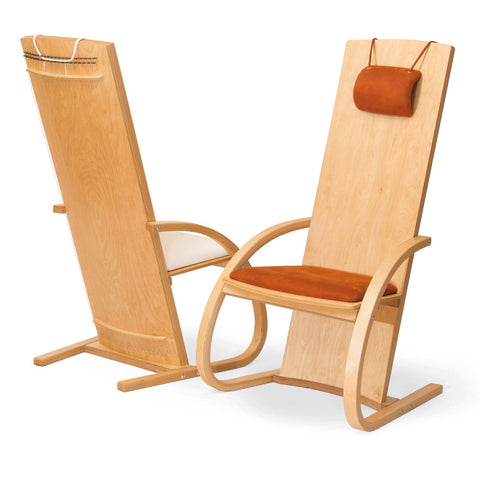
A 9-year-old with autism and pervasive developmental delays asked one day: "Can I sit in that chair?" He removed his shoes — knowingly, though I'm not sure how he knew — and closed his eyes. "I am breathing to the tones," he said.
It became his favorite opening ritual. We added nature's sounding instruments in subtle blends on the blanket of stringed tones. Slide whistles became birds that blended his breathing with the strings. Sometimes there were journeys with animals; at other times, sleep — not deep sleep, but what I perceived as a meditative state.
I had not expected this from a 9-year-old who was usually hard to keep still. The monochord singing chair seemed to provide a place of comfort and trust — and from the meditations, our sessions would move into fully sustained interactive attention for the remaining 30 minutes.
The effects of the singing chair were not in any way what I would have ever considered using for a child with PDD who had hyperactivity.
We have recently moved this instrument to our in-patient hospital music room and are beginning to quantifiably and qualitatively measure its effect on pain and recovery. We are grateful that the monochord singing chair is so often part of our treatment regimen and look forward to collecting data on its use with patients of all ages experiencing severe pain.
The clinical observations described above are supported by a growing body of peer-reviewed research on sound healing and vibrational music therapy.

Our latest version of the singing chair is the MonChair — which doubles as a space-saving office chair with multiple functions, available with cushions in a variety of colors.


