


This photo guide shows you examples of how to position the body monochords — the Monolini and Monolina by feeltone — on the physical body for a sound massage session.
Because the feeltone Monochords have a convex shape, the instrument floats naturally atop any size or shape of body — like a boat on water. The sound is felt through the resonance of the wood directly into the body, making it a uniquely powerful therapeutic tool.
We recommend a continuous, light strumming style. Playing too robustly can be overly stimulating — a gentle touch is best for most therapeutic applications, helping to entrain the breath and heart to a state of calm and ease.

Placing the monochord on the torso allows the body to feel vibrations most intensively. With the client in a supine (face-up) position, the instrument can be placed horizontally or vertically across the body.
The instrument can also be placed on the lower body, where vibrations travel up and down the legs and into the pelvis and hips.

With the client in a prone (face-down) position, the monochord can be placed on the back. For some clients this intensifies vibrations felt up and down the spine; for others the sensations are more subtle. Either way, this position can induce a deep state of relaxation.
Some clients may prefer lying on their side, with the instrument leaning against the body — a great option for those who find it difficult to lie face-down.

Feeling the monochord played on the soles of the feet for the first time is an incredible experience for many clients. The vibrations can be so powerful that a single strum — letting the sound ring out fully before strumming again — is recommended. Continuous strumming on the feet may be too stimulating for some.
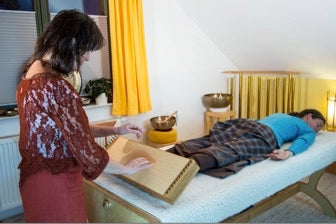
The monochord can also be propped at an angle against the soles of the feet with the client face-down, allowing sound to travel up through the entire body.

It's also possible to use the monochord therapeutically on yourself. Since it's not easy to be both active and passive simultaneously, we recommend strumming on the in-breath, then relaxing completely on the out-breath as the sound vibrates. Only once the sound has fully decayed should you strum again — then release, relax, and receive. This becomes a beautiful meditation practice where the instrument is your duet partner.
The Monolina and Monolini are built to the same length but differ in width and string count:
Note: the Monolini is tuned the same as the Monolina — it's simply a smaller instrument.
For both sizes, the A and C tunings are slightly higher and lilting with more audible overtones. The G, F, and D tunings are lower with stronger physical vibrations. The D tuning is the lowest in the series — the most bass-rich and earthy.
Not sure where to start? We put together a handy guide on how to choose a monochord.
We have a thriving monochord community with monthly free Zoom meetups, a content library, and intensive trainings for those who want a deeper dive into creating overtones with these beautiful instruments. Our office is in California near San Francisco, and we work with therapists, musicians, and music stores across the country.
Don't hesitate to reach out if you have any questions — we're happy to help you find the right instrument.
Your We Play Well Together Team!


