Hokema includes magnets with the B17 to help you mark chords while playing. Watch the video below to see how to use them, plus get a feel for the instrument's rich, full sound.
Hokema also includes a booklet with your purchase featuring song samples and playing techniques to get you started.
Scale & Tuning
C-Major scale, 440 Hz: C, D, E, F, G, A, B, C, D, E, F, G, A, B, C, D, E
A C-Major scale has 7 notes. The B17 gives you two full octaves, plus C, D and E in a third octave, for 17 tines in all.
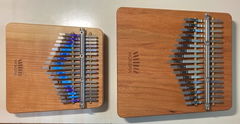
Tines from left to right: D, B, G, E, C, A, F, D, C, E, G, B, D, F, A, C, E. The lowest C is the long tine in the middle.
Note on notation: In the tablature, the second octave tines are marked with a dot (e.g. 1·, 2·, 3·) and the three highest tines in the third octave are marked with a colon (e.g. 1:, 2:, 3:).
How to Read the Tine Layout
Hokema marks the tines with two visual indicators to help you navigate the larger number of tines:
A single horizontal line on three tines indicates the keynote C — the low, middle, and high C
A double crossbar indicates the tone B (written as H in German notation)
These markings allow you to visually orient yourself quickly while playing.
Playing the C-Major Scale
Start with the middle, longest tine and pluck it with your right thumb, alternating with your left thumb, working your way outward to the shorter tines. You will hear the C-Major scale played over two and a third octaves.
In the tablature, notes for the left hand appear at the top and notes for the right hand at the bottom. This tablature format is used by Conny Sommer in his B17 tutorials.
First Wednesday of the month live on Zoom and Clubhouse App
5-6pm PT, 6-7pm MT, 7-8pm CT, 8-9 EST
Gather ‘round the fire & sip cocoa to the sweetest of sounds! Kick back as tinkling Kalimba serenades your soul under the stars. Bring your instrument to play or relax to metal tine melody morsels 💫🎶
Discover Hokema’s beautifully crafted kalimbas, made in Germany for rich, resonant sound and effortless musical expression. From the first note to everyday playing, each instrument invites you to slow down, explore, and make music intuitively.
While our Soundscapes are centered around the feeltone Monolina and Monolini and available in 4 tunings. But you don't need to own a monochord to take advantage of a matching collection.
Already have instruments? Find your root note and choose the collection that matches — then build from there. Starting from scratch? Browse the collections, listen to the tunings, and find the one that speaks to you.
Explore our Soundscapes and Start your own Collection
I’m loving this kalimba!
However, the highest note does not ring like the rest. And the third to highest note is ever so slightly flat.
But I know I’m going to love her.
Hokema B17 Mini Kalimba – 17 Key Thumb Piano, C-Major, Handmade in Germany
John S.
The B-17 Mini is a delightful instrument.
A few years ago I became casually interested in the Kalimba because of its simplicity of design and playability. Without experience or a good point of reference I needed to taste a lot of flavors to sort out the choices. For a while, my discards kept the local Goodwill store supplied with inventory.
The feeding frenzy stopped when I discovered Hokema. Build and material quality is professional grade. The tines are not stiff, so you can play at any intensity without stressing a thumb nails. Resonance from the solid wood base and the resulting sustain are simply stunning. Even the high notes sing, unlike the flat 'tapping an aluminum pan' sound from my discards.
I first purchased the B-17, and later the smaller B-17 Mini. Comments above apply to both. There is no problem holding, playing, or carrying around either instrument. The Mini's smaller footprint might be more comfortable for small hands. I just like the smaller package. Because the B-17's wood block is wider, it has more space between the tines. Both instruments appear to use the same tine assembly materials, but the Mini has a shorter cross bar. The Mini's tine spacing is grouped, but they can be adjusted to make the spacing more uniform like the B-17. In that mode, even with the smaller block the tine spacing is noticeably wider than some other Kalimbas I've tried. My thumbs are average width for a 5'8" person and my nails are normally rounded (not pointed), and I have no trouble playing individual notes.
Tablature is available around the net for 17-key Kalimbas (RiffSpot has a nice ebook), so you can play tunes without reading music on both the B-17 and B-17 Mini.
Hokema B17 Mini Kalimba – 17 Key Thumb Piano, C-Major, Handmade in Germany
Heide S.
Monochord Training Level 1 and 2
I just took the week-long monochord training with Joule and fell in love with my Monolina. Joule is a fun, engaging and knowledgeable teacher who brings deep reverence to her instruments and the art of playing them. We got to experiment with and experience all the different ways of expressing through our monochords and came away with a proven, complete and beautiful 45-minute session we can now offer. I highly recommend this class.
In-Person Monochord Training – $100 Deposit to Reserve Your Spot
Gina L.
Hokema kalimba b17
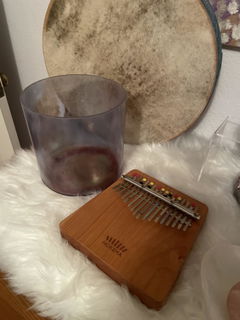
Wonderful instrument. It’s easy to travel with and well crafted. Customer service is wonderful as well. Very responsive. I am always impressed with the attention to customer service and care of the instruments. This instruments complement my crystal singing bowls and monalina nicely.
Hokema Kalimbas and Sansulas Showroom sale
Rachel N.
Life changing vibration
This set elevates one’s instruments to the next level. Having all these components really sets one up for success and allows room for growth to grow into your sound practice.
The versatility that comes with having the leg extensions allows the player to be comfortable in a variety of ways while playing. The mallets add additional ways to play.
Tuning is a breeze with the template. When not being played or on the go with this monolina, the mats keep everything safe and the backpack makes it so you can take it to the studio or out into nature to play.
I can’t say enough great things about it, it’s a must have in the sound tool kit for sure.
feeltone Monolina Travel Set – Monochord with Bag, Stand & Mallets
These chimes are absolutely beautiful. The sound is stunning. We own the original 4 elemental chimes and couldn’t wait to purchase these. They did not disappoint. We used them the day after they arrived in one of our scheduled sound baths to great delight.