⚠️ Limited Edition — What you see in stock is likely all we can get this year. Once these are gone, we do not expect to restock until 2027. If your preferred tuning is sold out, contact us to be added to the waitlist.
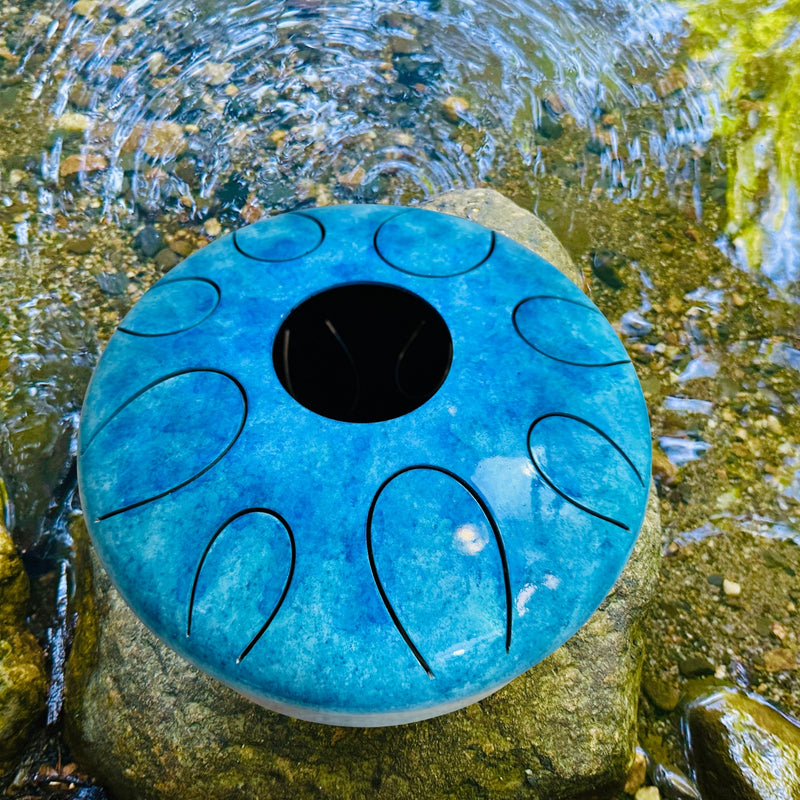
The Kigonki Monaural Tongue-Gong plays like a tongue drum and pulses like a singing bowl, with a long, warm sustain in four color-coded tunings.
- Handcrafted and hand-painted in Spain. Each one is unique.
- 8 tuned steel tongues on the front, with 8 matching tongues on the back that resonate in response.
- Creates natural monaural beats, a soft pulsing "wah-wah-wah," right in the room.
- Imported to the USA exclusively by We Play Well Together.
Tuned to match our Intuitive Soundscapes Collection
All tunings are at 440 Hz. The Blue D-minor Kigonki also pairs beautifully with our F monochord.
How to play
- Strike the front tongues with the mallets or your hands. The back resonates on its own.
- Play it like a drum: it rests at an angle on three small feet.
- Hold it by the wooden handle and walk with it through a sound bath, or swivel it on its rope for moving, evolving sound.
- Remove the handle to hang it from a medium gong stand.
- The tongues are large, so it's easy to learn with no special training.
Specifications
- Material: steel, hand-painted
- Size: 11" diameter, 6" high
- Weight: 4.4 lb
- Included: padded bag and 2 mallets
FAQ
What's a Monaural Tongue-Gong?
At first glance it looks like a tongue drum. And it is, but also much more:
-
Tongue drum: a percussion instrument in the idiophone family that produces bell-like, soothing tones when its pre-tuned metal "tongues" are struck with mallets.
-
Gong: a circular metal percussion disc, hung vertically in a frame and struck with a mallet for a deep, resonant, echoing sound.
-
Monaural beat frequencies: through acoustic phase interference, sound waves alternately cancel and reinforce each other. This creates a physical, audible volume pulse that sounds like a rhythmic, soothing "wah-wah-wah."
Unlike binaural beats, which need headphones to trick your brain into processing two different frequencies, monaural beats are a physical, acoustic phenomenon that happens completely in the air. The classic acoustic instrument that naturally creates monaural beats is the Himalayan singing bowl.
Who is this instrument for?
The intuitively played Monaural Tongue-Gong is for sound practitioners who want what is essentially a 3-in-1 high-grade instrument with therapeutic-grade sound quality.
You can find many cheaply mass-produced tongue drums on the market. Only therapeutic-grade instruments with superior sound quality are suitable for sound therapy, sound baths and sound healing.
How do you use it?
You can play the Monaural Tongue-Gong sideways like a drum (it rests on little feet on one side), hold it by its smooth wooden handle and walk around with it, or remove the handle to hang it from a gong stand. Because the tongues are large, it's very easy to learn to play, with no special training required.
What's so special about this instrument?
The Monaural Tongue-Gong has an incredibly long sustained tone and produces mesmerizing beat frequencies that pulse like a singing bowl. Its sound also layers gorgeously with singing bowls, and it comes in tunings that match each of our five monochord tunings: C, A, D, G and even F (the Blue D-minor Kigonki goes with F!).
What are monaural beats?
When two tones very close in pitch sound together, their waves alternately reinforce and cancel each other. You hear this as a gentle, rhythmic pulse. On the Kigonki, each front tongue and its matching back tongue create this pulse, much like a Himalayan singing bowl.
Do monaural beats need headphones?
No. They happen acoustically in the air, so everyone in the room hears them. That makes the Kigonki well suited to group sound baths.